18 September 2001
Pakistan and Afghanistan
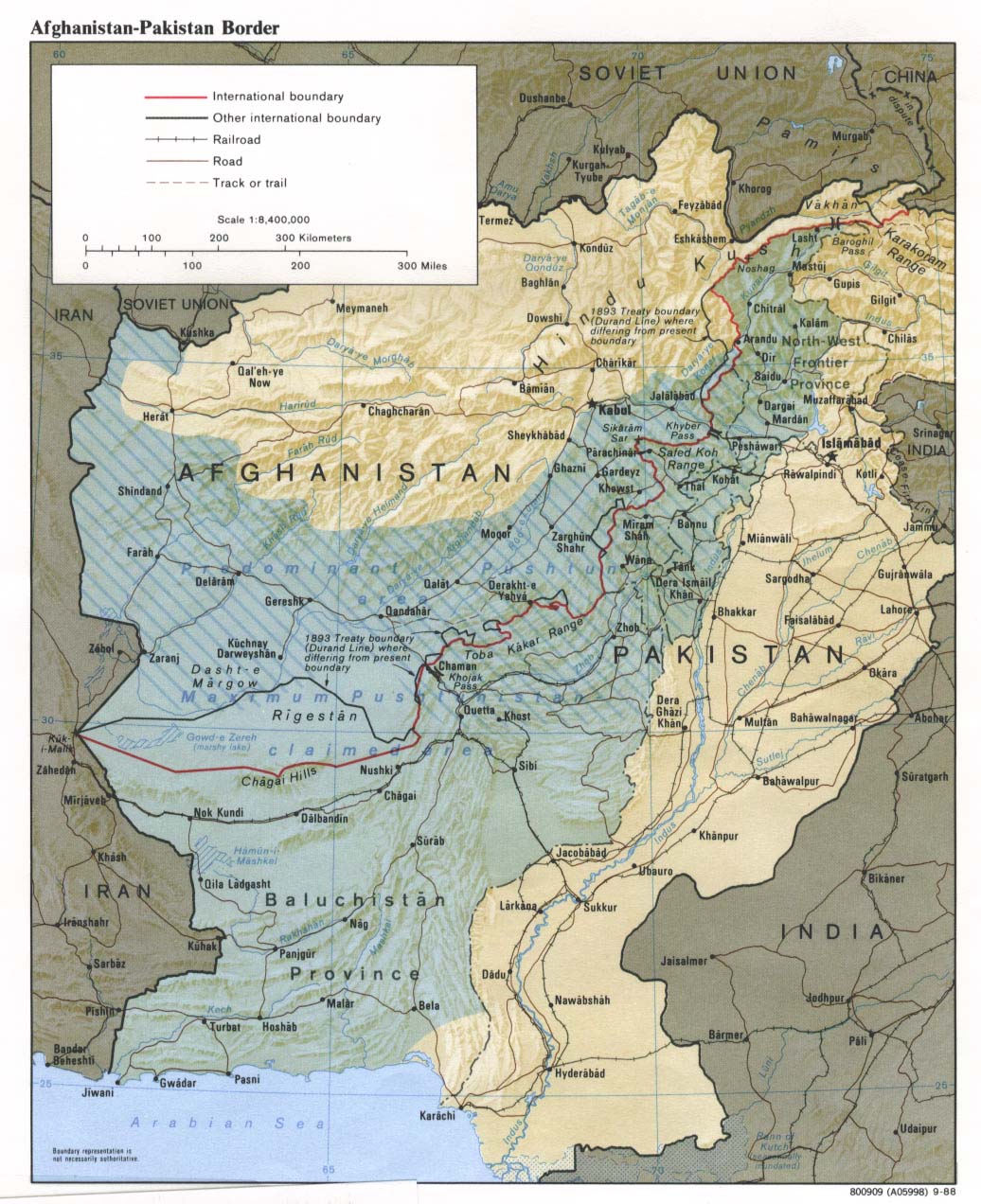
Afghanistan-Pakistan border (1988)
By all media accounts, the United States has brought considerable pressure to bear on Pakistan for assistance in dealing with the terrorist threat emanating from Afghanistan. We know the Pakistanis have sent a delegation to pressure the Taliban to turn over Osama bin Laden, and the sensible among us know this is unlikely.
Most journalists and pundits assume that Pakistan is a crucial base for the military action they assume is coming from the United States against Afghanistan. I don't necessarily share that view, but part of my work requires that I work through various scenarios. So, arguendo, let's assume that Pakistan is going to be pressured by the U.S. government into an alliance with the United States in a significant anti-Taliban, anti-terrorism operation in Aghanistan.
My first question is, can General Musharraf (President of Pakistan) even survive such an alliance? And can Pakistan as we know it? In an excellent article that is roughly one year old, Robert Kaplan is way ahead of every analyst in noting the fragility of Pakistan, a potential "Yugoslavia in the making. . . ." Kaplan further notes the precarious position of Musharraf, who is, in Pakistani terms, a relatively liberal reformer, certainly much more so than most of the fellow military officers (dominated by radical Muslims) who helped install him during the 1999 coup and might just as easily remove him. And that could be the spark that ignites the Pakistani tinderbox.
Kaplan contends that "Afghanistan and Pakistan should be seen as one political unit." What if Pakistani aims to dominate Afghanistan and render it a strategic counterweight to India suddenly were reversed -- that is to say, tribal elements within Pakistan sympathetic to the Taliban were to become ascendant as a direct result of US efforts to draw Musharraf into the anti-terrorism effort? Those elements would then control Pakistan's nuclear capability. And things could then get very messy.
Now, this is just speculation on my part, only one scenario of many, and fairly unlikely. But these are the sorts of matters that serious analysts and scholars of international politics consider, unlike idealists like Pat Buchanan and the isolationist Left/Libertarian fringe, whose Fortress America does not even possess the ability, as events last week demonstrated, to defend office buildings within the direct territory of the United States, let alone knock down nuclear missiles acquired by rogue states. As well meaning as the isolationist fringe is, I tend more towards Doc Rood's advice: "It is only a charming conceit to suppose that fearful things cannot happen if one refuses to believe that they will."
[Posted @ 09:07 PM CST]